
IFCEXPORT command
Exports a BIM model to IFC.

Icon: 
Description
Exports a BIM model to IFC, partially or entirely. IFC attributes are managed dynamically, for example properties and property sets. This allows you to choose between IFC2x3 or IFC4 attributes.
- BricsCAD BIM created IFC files can be used in different coordination workflows with many tools (for example, Solibri).
- Some software programs allow for editing only IFC files created with specific Authoring Tools, while actively blocking files created with other tools. Other uses of BricsCAD BIM created IFC files on these software programs are possible (for example, viewing).
- BricsCAD BIM also supports exporting files in RVT format (for viewing only).
Method
Select the entities to export or press Enter to export the entire model.
The Export To IFC dialog box opens to control the export settings.
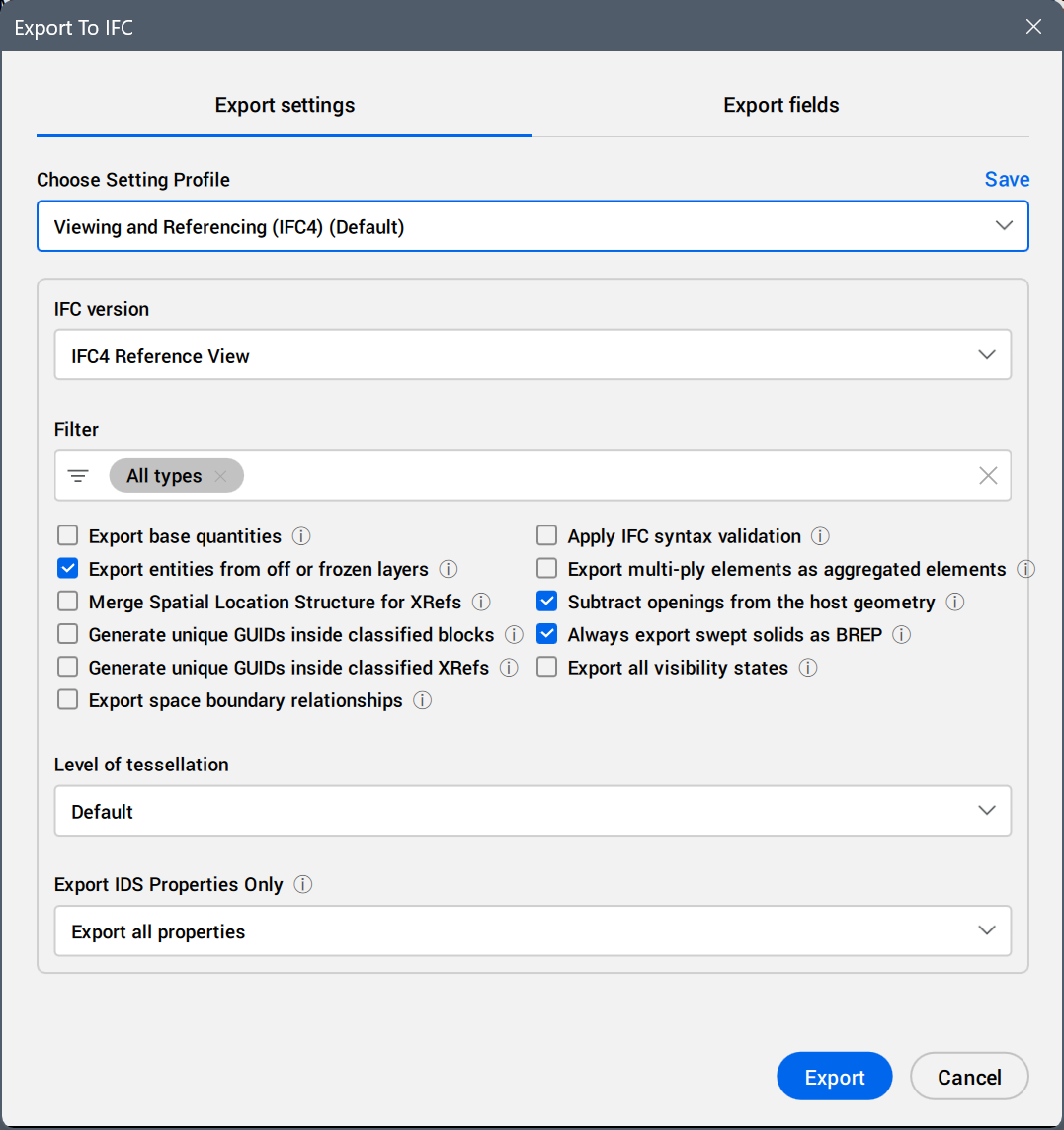
Choose Setting Profile
Defines the setting profile to be used when exporting the model.
Select a profile from the drop-down list.
- Viewing and Referencing (IFC4) (Default)
- This is the default profile for most cases, ensuring reliable geometry and property exchange. Files might be larger, and editing in the target software might be more difficult.
- Design Transfer (IFC4) (Unofficial)
- Use this to allow editing in the target software. However, Design Transfer is an unofficial version, and not well supported by many software.
- Full Export (IFC4)
- Use this to support everything from your BIM model (including base quantities, entities hidden by visibility states, etc.). This may increase the file size significantly.
- Minimal File Size (IFC4)
- Use this to minimize the file size. Since this profile relies on Design Transfer, not all software might be capable of opening this file correctly.
- Viewing and Referencing (IFC2x3)
- Use this in case the older IFC2x3 is needed. Note that IFC2x3 doesn't support many BIM types.
- IFC4x3
- Use this for exchanging Civil or Infrastructure data.
- IFC-SG
- Use this to comply with the IFC-SG in Singapore.
You can edit the settings and click Save to update the current profile or to create a new one. To create a new profile, enter a new profile name in the Save Profile dialog box and click OK.
Profile settings
- IFC version
- Defines the version of the exported IFC file format. Select a format from the drop-down list.
- IFC2X3
- IFC4 Reference View
- IFC4 Design Transfer View
- IFC4X3 (IFC 4.3.2.0)
- Filter
- Defines the entities to export based on the selected entity types. By default, All entities are exported.
Click the field to display the BIM entity type tree and adjust the selection. Select or deselect entire BIM type categories or individual BIM types.
After deselecting a category of element types in the tree list, the All entities tag in the field is replaced by the remaining categories tags.
After deselecting an element type under a category in the tree list, the category tag in the field is replaced by the remaining entity type tags.
Click the
 button next to a tag's name to remove the corresponding entity type or category from the selection.
- Other settings
-
Note: Depending on the selected IFC version, some options are not available.
- Level of tessellation
- Select a value from the drop-down list.
The options Default, Low, Medium, and High are available.
- Export IDS Properties Only
- When an IDSXML has been imported, this allows you to export only the properties required by the IDS.
Select a value from the drop-down list.
The options Export all properties and Export only the properties required by the IDS are available.
Note: When Export only the properties required by the IDS is selected, only the IFC and custom properties specified in the imported IDS file are exported.
Export fields tab
- Export author name
- Type in the author name to be exported as part of the header of the IFC file.
- Export organization name
- Type in the organization name to be exported as part of the header of the IFC file.
- Export authorization
- Type in the authorization (person who authorized the sending of the file) to be exported as part of the header of the IFC file.
- The import and export of Alignments and TIN Surfaces with IFC4X1 is supported.
- A color resembling the material by layer color is applied for entities with Redway materials.
- To export properties with date values to IfcDate for IFC4, use the YYYY-MM-DD format. Different formats are exported as IfcLabel.
For more information about IFC export, see the IFC import and export in BricsCAD article.