
The BricsCAD application window
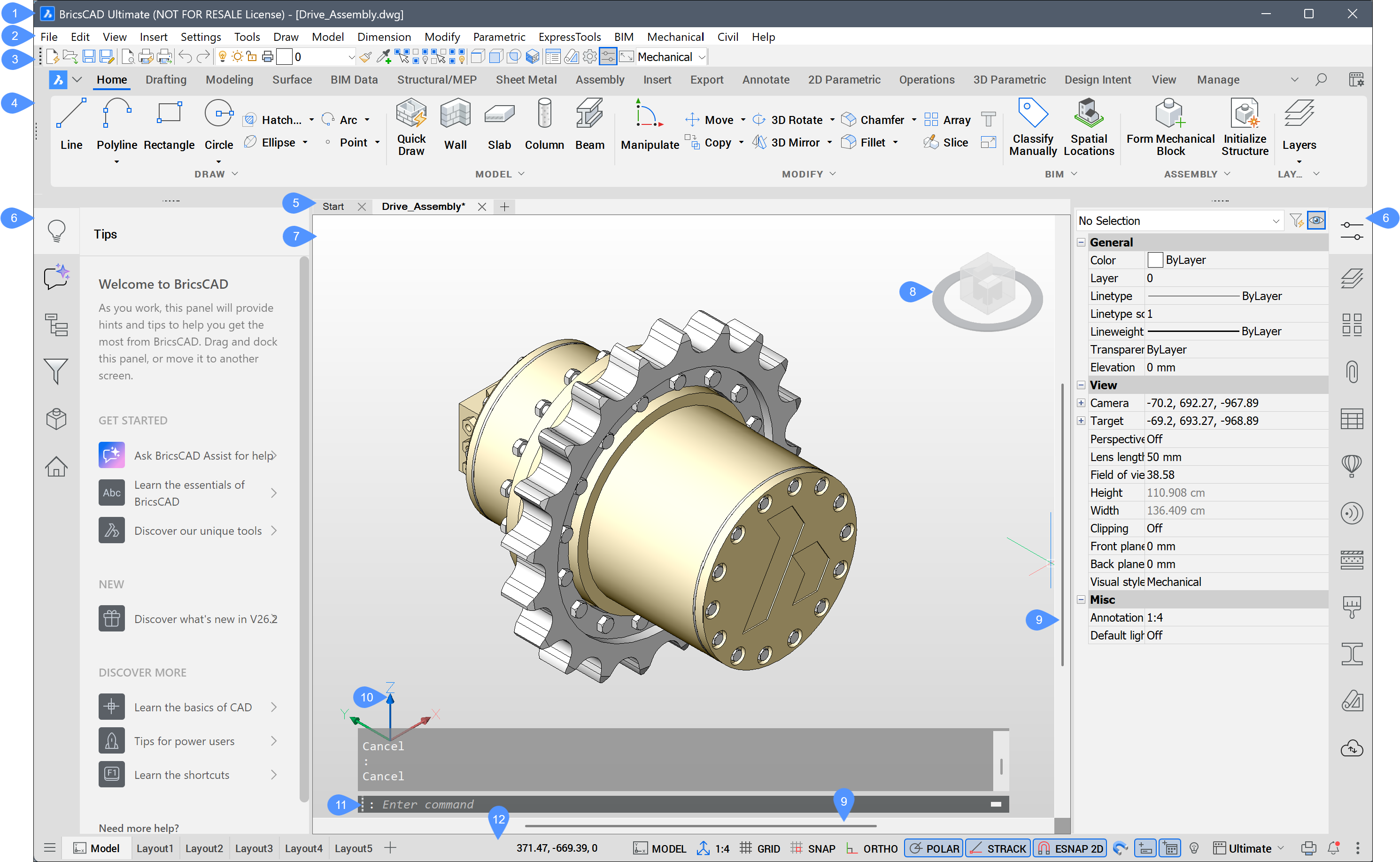
- Title bar
- Menu Bar
- Toolbar
- Ribbon
- Document tabs
- Panels
- Drawing area
- LookFrom control
- Scroll bars
- UCS Icon
- Command line
- Status Bar
Components of the BricsCAD application window
- Title bar
- Displays the application name and current license level.
- Menu Bar
- Displays the main menus, at the top of the BricsCAD application window.
To display or hide the menu bar, do one of the following:
- Right click a toolbar, ribbon or panel, then choose Menu Bar in the context menu to toggle the display.
- Set the MENUBAR system variable.
- Toolbar
- Displays an icon‑based tool that groups related commands together for quick access. Toolbars can be floating or docked to any edge of the BricsCAD window.
To display or hide a toolbar, do one of the following:
- Launch the TOOLBAR command.
- Right-click a toolbar, ribbon, or panel, select Toolbars from the context menu, and choose the desired toolbar.
Tip: See the Toolbars and Creating toolbars articles for information about customizing existing toolbars or creating your own custom toolbar.
- Ribbon
- Displays a set of tabbed toolbars, filled with tool buttons and other graphical control elements, grouped by functionality.
To display or hide the ribbon, do one of the following:
- Run the RIBBON or RIBBONCLOSE command.
- Right-click a toolbar, ribbon, or panel, select Panels, and choose Ribbon from the context menu.
Tip: See the Customizing the ribbon article for information about customizing the ribbon.
- Document tabs
- Displays the open document tab for each currently open drawing and for the Start page, at the top of the graphical screen.
To display or hide the document tabs, set the SHOWDOCTABS system variable.
- Panels
- Displays the active panels. Click an icon to open the associated panel.
To display or hide a panel, do one of the following:
- Launch the specific command to open or close the panel.
- Right click a toolbar, ribbon, or panel, select Panels, and choose the desired panel.
- Drawing area
- Displays the drawing area.
- LookFrom control
- Allows you to switch between a number of preset view orientations, such as orthographic views and isometric views. By default, the LookFrom control is displayed in the top right corner of the graphic screen.Tip: See the Using the LookFrom control article for more information.
- Scroll bars
- Scroll bars are off by default.
To display or hide the scroll bars, do one of the following:
- Hold down the Shift key and press the F4 function key.
- Run the SCROLLBAR command.
- UCS Icon
- Shows the nature of the current coordinate system. UCS stands for a User-defined Coordinate System.
The display of the icon is controlled through the UCSICON system variable and the position of the UCS icon is defined by the UCSICONPOS system variable.
- Command line
- Displays prompts and a command input field for running commands.
To display or hide the Command line, do one of the following:
- Run the COMMANDLINE or COMMANDLINEHIDE command.
- Right-click a ribbon panel or toolbar and choose Command Line from the Panels list.
- Use the Ctrl+9 keyboard shortcut.
- Use the Shift + F2 keyboard shortcut.
- Status Bar
- Displays the model and layout tabs, along with various tools and their current status.
Right click a toolbar, ribbon, or panel, then choose Status Bar in the context menu to toggle the display of the Status Bar On/Off.
Interface Settings
The Interface Settings button is located at the top-right corner of the Ribbon. The RIBBONSETTINGSENABLED system variable controls whether the button is displayed or not.
The Interface Settings dialog box allows you to manage the interface display of your BricsCAD workspace. See the Interface Settings dialog box related article.
The color theme
The COLORTHEME system variable sets the color theme for the ribbon, panels, dialog boxes, etc. You can choose between a dark or a light color theme.
To set the color theme, do one of the following:
- Type COLORTHEME in the Command line and choose 1 for light or 0 for dark.
- Right-click on a toolbar or ribbon panel and select Dark Interface in the context menu.
- Open the Interface Settings dialog box and choose a Theme.
Hiding a selection of user interface elements
The CLEANSCREENON command allows you to hide a selection of user interface elements simultaneously.
The CLEANSCREENOPTIONS system variable defines which user interface elements are hidden.
The Ctrl+0 keyboard shortcut toggles the cleanscreen state.
On AZERTY-keyboards:
- Do not use the numeric keypad.
- Do not press the Shift-key when hitting the number key.